
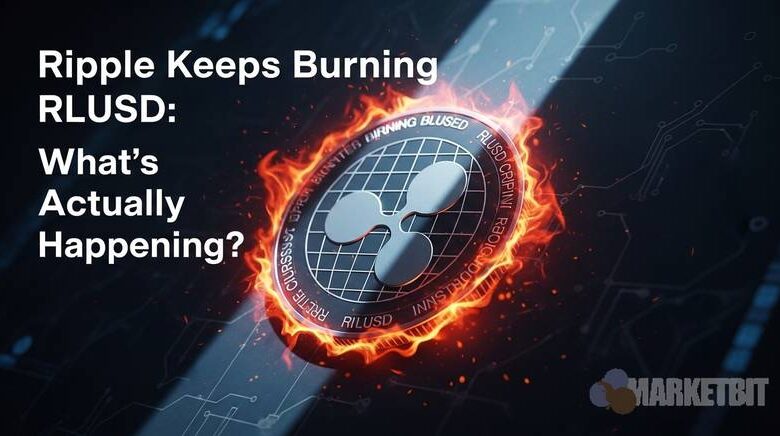
Ripple has burned 35 million RLUSD tokens in a single day, continuing a weeks-long pattern of large-scale stablecoin destruction that has trimmed the token’s circulating supply from $1.6 billion to roughly $1.4 billion. The burns, which span both the Ethereum and XRP Ledger networks, reflect redemptions where holders exchange RLUSD for underlying U.S. dollars, but the pace and scale have drawn attention from analysts questioning whether something deeper is at play.
What Is RLUSD and Why Does Ripple Burn It?
RLUSD is Ripple’s dollar-backed stablecoin, launched in December 2024 after receiving approval from the New York Department of Financial Services. It maintains a 1:1 peg with the U.S. dollar, currently trading at approximately $0.9999, and operates natively on both the XRP Ledger and Ethereum.
Key Milestone
Dec 2024
RLUSD launched following NYDFS regulatory approval, one of the first fully regulated stablecoins native to the XRP Ledger, backed 1:1 by USD held in custodial accounts.
Source: Ripple / NYDFS
Like all fiat-backed stablecoins, RLUSD operates on a mint-and-burn cycle. When users or institutions deposit U.S. dollars, new tokens are minted. When they redeem tokens for dollars, those tokens are permanently destroyed.
This mechanism is not unique to Ripple. It is how reserve-backed stablecoins maintain their peg: circulating supply must match the dollars held in custody at all times. Burns, in isolation, are not a sign of distress. They simply mean someone cashed out.
What makes Ripple’s recent activity notable is the frequency and volume. The burn pattern over the past two weeks has been, as crypto lawyer Bill Morgan put it, “largely different from what has happened so far,” raising questions about whether routine liquidity management explains the full picture. Similar questions about supply dynamics have surfaced in other tokens, where shifts in spot flow signaled changing institutional behavior.
The On-Chain Evidence: A Two-Week Burn Spree
The numbers paint a clear picture of accelerating destruction. On March 26, 2026, Ripple burned 35 million RLUSD across multiple transactions on both Ethereum and the XRP Ledger. Two days earlier, approximately 40 million RLUSD were burned in a separate batch.
RLUSD Supply Management
35M RLUSD Burned
On March 26, 2026, Ripple conducted multiple burn transactions across the XRP Ledger and Ethereum, continuing a two-week pattern of aggressive supply reduction.
Source: U.Today / on-chain data
The March 26 burn broke down as follows: an initial destruction of 26 million RLUSD on the Ethereum network, followed by additional burns of 5 million, 2.9 million, and 1.9 million across networks. These are publicly verifiable via Ethereum block explorers and XRPScan, with the @RL_Tracker account on X monitoring each event in near-real time.
Earlier in the month, Ripple conducted what was then its largest single RLUSD burn ever: 10 million tokens destroyed on the XRP Ledger on March 10, 2026. A secondary burn of roughly 1 million RLUSD followed on Ethereum the day before. In a notable twist, Ripple had minted 69 million RLUSD in the days immediately preceding those burns, suggesting a rapid deposit-and-redeem cycle by one or more large holders.
Separate from the March events, a prior burn removed 25 million RLUSD from Ethereum’s supply, and another 9 million were burned at Treasury as supply management slowed temporarily. The cumulative effect has been a market cap decline from approximately $1.6 billion to roughly $1.4 billion during the burn period.
Despite these reductions, RLUSD’s growth trajectory remains steep. Since its December 2024 launch, the stablecoin’s circulating supply has grown 1,278% year-to-date, reaching approximately 1.4 to 1.5 billion tokens. The burns represent a correction within a broader expansion, not a collapse.
What Repeated Burns Signal for RLUSD’s Stablecoin Strategy
Frequent burns in a young stablecoin can indicate healthy demand cycles. Large institutional players deploying capital into RLUSD for cross-border settlements or liquidity purposes, then withdrawing when the use case is fulfilled, would produce exactly this pattern. The broader movement of assets across exchanges in the XRP ecosystem adds context to the redemption activity.
Ripple has positioned RLUSD as an institutional-grade tool for its On-Demand Liquidity corridors. Ripple President Monica Long has emphasized the company’s regulatory foundation, noting that Ripple holds “75+ licenses worldwide and counting,” framing compliance as the competitive moat that differentiates RLUSD from less regulated alternatives.
That regulatory positioning matters in how the burns should be interpreted. Because RLUSD is fully backed and regulated under NYDFS oversight, burns are not discretionary. They are legally required when holders redeem tokens. The reserve ratio must stay at 1:1, which means every dollar withdrawn triggers a corresponding token destruction.
This stands in contrast to how larger stablecoins operate. Tether’s USDT, with a market cap exceeding $140 billion, and Circle’s USDC at roughly $50 billion, rarely conduct burns of comparable relative magnitude. Ripple’s model is more conservative: tokens are burned before new supplies are minted, rather than maintaining a persistent float. The growing competitive landscape among stablecoin issuers makes this transparency increasingly relevant.
The transparency itself may be RLUSD’s strongest differentiator. Every mint and burn is visible on-chain, tracked by independent monitors, and verifiable by anyone with a block explorer. As regulatory scrutiny of stablecoins intensifies through 2026, that auditability could become a competitive advantage over issuers with less granular public reporting.
Crypto lawyer Bill Morgan’s public questioning of the two-week pattern, asking whether it represents “healthy liquidity management or something else entirely,” reflects a community that is watching closely but not alarmed. Burns are a normal stablecoin mechanism. The scale is new for RLUSD, but the mechanics are well understood.
What bears watching next is whether the burn cadence continues, stabilizes, or reverses into net minting. A sustained period of burns without corresponding new mints would suggest net outflows from RLUSD, while a return to minting would indicate fresh institutional deposits. The on-chain data will show which direction the stablecoin is heading before any official announcement does.
Disclaimer: This article is for informational purposes only and does not constitute financial or investment advice. Cryptocurrency and digital asset markets carry significant risk. Always do your own research before making decisions.