

Ripple CTO Emeritus David Schwartz has publicly denied claims that the company secretly pre-allocated XRP escrow tokens to institutional buyers through hidden contracts, calling the viral allegation flatly false.
The denial came after an X user alleged that Ripple had quietly earmarked the majority of its XRP escrow releases for hidden institutional players via private contracts, leaving retail investors uninformed and disadvantaged.
Schwartz’s response was unambiguous. “You are correct. I absolutely never said that,” he stated on X, rejecting the claim that he had ever confirmed the existence of such arrangements.
What Are Pre-Allocated XRP Contracts? Understanding the Rumor
The allegation centers on Ripple’s well-known escrow mechanism. Ripple holds billions of XRP in a series of escrow accounts that release tokens on a scheduled basis each month. The system was designed to provide predictable supply and prevent Ripple from flooding the market.
The rumor claimed that these scheduled releases were not going to the open market as publicly understood, but were instead secretly earmarked for institutional buyers through private, undisclosed contracts. Under this theory, large players received priority access to XRP before retail participants could acquire tokens from escrow releases.
The claim gained traction on X and crypto forums, where XRP distribution practices have long been a topic of debate. Given Ripple’s history of regulatory scrutiny, particularly around its ongoing legal battles, allegations about hidden institutional deals struck a nerve with parts of the community.
No independent evidence has surfaced to support the claim. No third-party audit, on-chain analysis, or leaked documentation corroborates the existence of pre-allocated contracts within Ripple’s escrow framework.
Schwartz’s Response: Why He Says the Contracts Don’t Exist
Schwartz, who serves as Ripple’s CTO Emeritus and is one of the original architects of the XRP Ledger, addressed the claim directly on X. His denial targeted a specific assertion: that he had personally confirmed the existence of pre-allocated escrow contracts for institutional buyers.
The response left little room for interpretation. By stating he “absolutely never said that,” Schwartz rejected both the substance of the claim and the suggestion that he had ever lent it credibility.
This was not an isolated instance of Schwartz correcting misinformation. Just two days earlier, he publicly rejected proposals to offer banks artificial incentives or “fake discounts” to adopt XRP, arguing that such subsidies create fragile, unsustainable business models.
The back-to-back clarifications suggest a pattern: Schwartz is actively monitoring and pushing back against narratives about XRP distribution that he views as inaccurate. As one of the most recognized voices in the Ripple ecosystem, his public statements carry significant weight with both the community and outside observers.
What This Means for XRP and Ripple’s Transparency Record
Ripple has historically published quarterly XRP market reports detailing escrow releases, token sales, and distribution figures. These reports represent the company’s primary transparency mechanism for its token management practices.
Despite these disclosures, questions about institutional versus retail fairness in XRP distribution have persisted. The XRP community remains divided: supporters view Schwartz’s denial as clearing the air, while skeptics argue that the opacity of institutional crypto arrangements across the industry makes full verification difficult.
XRP was trading at approximately $1.36 at press time, down 1.9% over the past 24 hours and 6.2% over the week. The token holds a market cap of roughly $83.5 billion, ranking it fifth among all cryptocurrencies, with 24-hour trading volume near $2.58 billion.
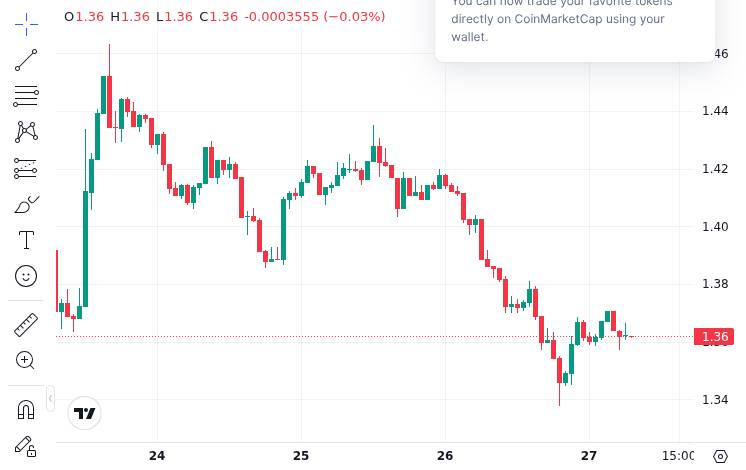
The price movement does not appear directly tied to the rumor or the denial, with XRP tracking broader market softness rather than reacting to the social media exchange.
Ripple’s regulatory environment adds context to why these allegations matter. The company’s prolonged legal battle with the SEC put its token distribution practices under a microscope, and any suggestion of hidden institutional deals, even unsubstantiated ones, risks reigniting scrutiny from regulators and institutional market participants alike.
Whether Schwartz’s denial puts the rumor to rest remains an open question. In crypto markets, executive clarifications sometimes settle debates, but they can also amplify the original claim by drawing attention to it. For XRP holders, the absence of any corroborating evidence for pre-allocated contracts, combined with a direct on-the-record denial from Ripple’s most technically authoritative voice, shifts the burden of proof squarely onto those making the allegation.
Disclaimer: This article is for informational purposes only and does not constitute financial or investment advice. Cryptocurrency and digital asset markets carry significant risk. Always do your own research before making decisions.