
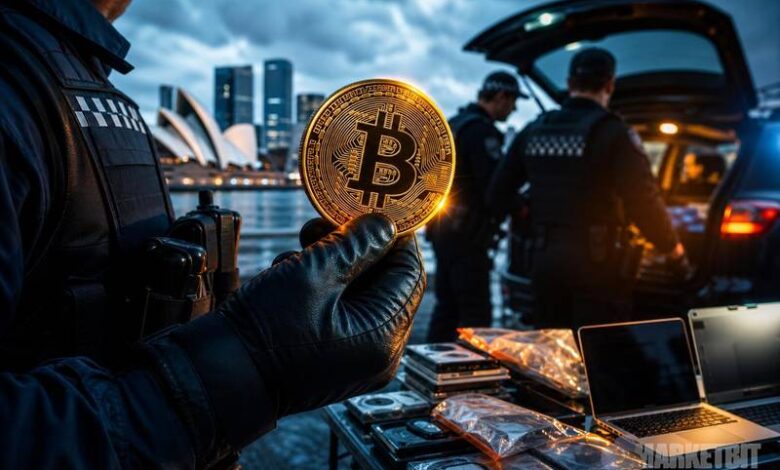
Australian police have reportedly seized $4.1 million in Bitcoin as part of an investigation into an alleged darknet marketplace, according to a news release from New South Wales Police. The seizure highlights ongoing law enforcement efforts to trace cryptocurrency linked to illicit online activity, though key details about the case remain unverified.
What NSW Police Say About the $4.1 Million Bitcoin Seizure
WHAT TO KNOW
- Seizure amount: $4.1 million in Bitcoin, reportedly tied to darknet activity
- Alleged connection: The Bitcoin is linked to an alleged illegal darknet marketplace
- Verification limits: Independent confirmation of the marketplace connection and wallet provenance has not been established in available reporting
NSW Police published a news release announcing the seizure as part of a broader investigation. The agency attributed the seized Bitcoin to activity on an alleged illegal darknet market.
A separate report from Region.com.au referenced $6 million in total cryptocurrency seized during the same investigation, suggesting the Bitcoin component may be part of a larger enforcement action. The discrepancy between the two figures has not been publicly reconciled.
No specific wallet addresses, transaction hashes, or on-chain tracing details have been disclosed in available reporting. The identity of the suspect or suspects has not been confirmed in the materials reviewed for this article.
Why the Alleged Darknet Marketplace Link Needs Careful Attribution
The connection between the seized Bitcoin and a darknet marketplace is described as “alleged” in the available material. This distinction matters: a seizure confirms that law enforcement took custody of cryptocurrency, but it does not by itself prove the funds originated from illegal commerce.
Establishing that Bitcoin came from a specific darknet marketplace typically requires blockchain forensic analysis, wallet clustering, and court-admissible evidence linking addresses to illegal transactions. None of these technical details appear in the currently available public reporting.
Corroborating coverage from additional outlets was not fully captured during the research phase, which means independent verification of the marketplace allegation may exist elsewhere but has not been confirmed here. Readers should treat the marketplace connection as an unproven law enforcement allegation at this stage.
Seizure announcements in crypto-related investigations sometimes precede more detailed disclosures as cases progress through the courts. Whether additional evidence, including blockchain forensic reports, will be released in this case remains unknown. Previous enforcement-driven events have prompted analysts to watch for Bitcoin profit-taking signals in the broader market.
What the Seizure Does and Does Not Say About Bitcoin Market Impact
No verified Bitcoin price data, derivatives positioning, or on-chain metrics tied to this specific seizure announcement were available at publication time. All market data fields, including price, 24-hour change, market cap, and volume, returned no results from standard data sources.
For scale, a $4.1 million seizure is minimal relative to Bitcoin’s daily trading volume, which regularly exceeds tens of billions of dollars. Seizures of this size have historically not produced measurable price reactions, unlike larger enforcement actions such as the 2013 Silk Road seizure.
What may matter more over time is the broader pattern of law enforcement cryptocurrency enforcement actions across jurisdictions. Traders monitoring sentiment shifts around regulatory developments, similar to those tracked via tools like the Fear and Greed Index during low-volatility periods, may want to watch for follow-up disclosures from NSW Police.
Key items that remain unconfirmed: the identity of the alleged marketplace, the total scope of the investigation, whether additional arrests or seizures are expected, and whether any of the seized Bitcoin will be subject to forfeiture proceedings. Developments in stablecoin compliance, such as Circle’s recent growth in tokenized money market funds, suggest that regulatory scrutiny of crypto assets continues to intensify across multiple fronts.
Disclaimer: This article is for informational purposes only and does not constitute financial or investment advice. Cryptocurrency and digital asset markets carry significant risk. Always do your own research before making decisions.