
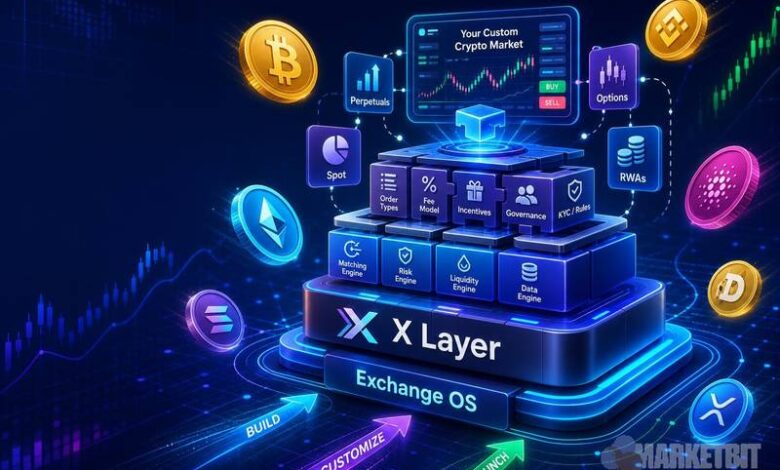
OKX’s X Layer blockchain has launched Exchange OS, a platform that enables users to deploy custom cryptocurrency markets for spot trading, perpetual contracts, and prediction outcomes. The launch, announced on May 26, 2026, positions OKX’s Ethereum Layer 2 network as modular exchange infrastructure rather than a single trading venue.
What Is Exchange OS and What Did OKX’s X Layer Just Launch?
Exchange OS is a permissionless deployment layer built on X Layer, OKX’s Ethereum-compatible L2 network. It allows operators to spin up fully functional trading venues, including spot markets, perpetual futures, and outcome-based prediction markets, all sharing a common execution environment on X Layer.
The platform is capable of processing up to 300,000 transactions per second with millisecond-level matching latency, performance figures that place it in the range of centralized exchange backends rather than typical onchain infrastructure.
OKX CEO Star Xu framed the product as a shift away from single-operator models.
“The next chapter of onchain finance should not be built by a single platform.”
Star Xu, CEO & Founder, OKX — OKX Blog
The first live market on Exchange OS will be a 2026 FIFA World Cup Outcomes prediction market, set to launch in June 2026. Public access to the broader platform opens in Q3 2026, with protocol-level improvements slated for Q4 2026 and beyond.
OKB, the exchange’s native token, surged +12.67% in 24 hours to $93.93 on the announcement day, with a 7-day gain of +14.97%. Trading volume hit $91.3 million, and OKB’s market cap reached $1.97 billion.
OKB — Exchange OS Launch Day
+12.67%
$93.93 (+14.97% 7-day)
Market cap: $1.97B | 24h volume: $91.3M | Source: CoinGecko
The price surge stands out against a broader market backdrop of caution, with the Crypto Fear & Greed Index sitting at 34, firmly in “Fear” territory.
How Custom Market Creation Works on Exchange OS
X Layer completed its migration to the OP Stack in December 2025 and integrated Aave in March 2026, building out the DeFi infrastructure that now underpins Exchange OS. The network functions as OKX’s dedicated Ethereum L2, giving Exchange OS access to Ethereum’s security guarantees while operating at significantly higher throughput.
Xu described the architectural logic in concrete terms: “Instead of fragmented venues functioning as isolated systems, Exchange OS creates a shared execution environment where different market types can coexist on common rails.”
Deployers must stake OKB in the X Layer Staking Contract before creating a venue. The exact staking threshold has not been disclosed, though one report described the requirement as “significant,” suggesting it functions as a financial filter for access rather than a nominal barrier.
This staking gate introduces a tension at the core of Exchange OS’s positioning. While OKX markets the platform as permissionless, the OKB staking requirement means access is gated by capital, a model closer to permissioned-lite than truly open deployment. For readers tracking DeFi infrastructure trends, this echoes broader debates about whether centralized entities can credibly build decentralized products.
The partner list signals institutional-grade ambitions. GSR, Kronos Research, and Chainlink are involved on the trading and oracle side, while Chainalysis, Alibaba Cloud, and Centrifuge bring compliance, infrastructure, and real-world asset tokenization capabilities. Pyth Network, Maple Finance, Glassnode, and Nansen round out the roster, alongside xStocks for equity-linked products.
Exchange OS also includes a compliance feature allowing operators to configure KYC-compliant venues within isolated risk groups, a design choice that gives institutional deployers regulatory optionality without imposing KYC on the entire network.
Where Exchange OS Fits in the DeFi Infrastructure Race
OKX is one of the world’s largest centralized exchanges, and Exchange OS represents a strategic bet on extending its reach into onchain exchange infrastructure. The move parallels a broader trend: L2 networks affiliated with major players are increasingly launching native trading primitives, as seen with Base’s ecosystem around Aerodrome and Blast’s integration with Thruster.
The most direct comparison is Hyperliquid, which has achieved high-TPS permissionless perpetuals trading without requiring any token staking gate. Hyperliquid’s model is fully open; Exchange OS’s OKB staking requirement creates a higher barrier to entry that may limit the long tail of market creators while potentially filtering for higher-quality deployments.
Uniswap v4’s hooks system offers another reference point. Hooks allow developers to customize pool behavior at a granular level, but within Uniswap’s AMM framework. Exchange OS goes further by offering full order-book infrastructure, but ties it to OKX’s L2 rather than running on general-purpose chains. The tradeoff is performance for neutrality.
The prediction market launching in June will be an early test case. Prediction markets have gained traction following Polymarket’s growth, and a major financial institution backing onchain prediction infrastructure could accelerate mainstream adoption of the format, particularly around high-profile events like the World Cup.
Liquidity routing is the key question. Exchange OS venues will initially draw from X Layer’s liquidity pool, which is smaller than Ethereum mainnet or established L2s like Arbitrum. Whether OKX bridges its centralized exchange liquidity into Exchange OS venues, and how transparently, will determine whether these custom markets achieve meaningful depth or remain thin.
For projects building on Exchange OS, the compliance-ready architecture could be a differentiator. As security and trust concerns continue to shape DeFi infrastructure decisions, the ability to deploy a market with built-in KYC rails may appeal to institutions that would otherwise avoid fully permissionless venues.
Stage 2 public access in Q3 2026 will be the real inflection point. Until then, Exchange OS remains a controlled launch with curated partners, and the gap between its permissionless branding and its staking-gated reality will face its first real stress test.
Disclaimer: This article is for informational purposes only and does not constitute financial or investment advice. Cryptocurrency and digital asset markets carry significant risk. Always do your own research before making decisions.