
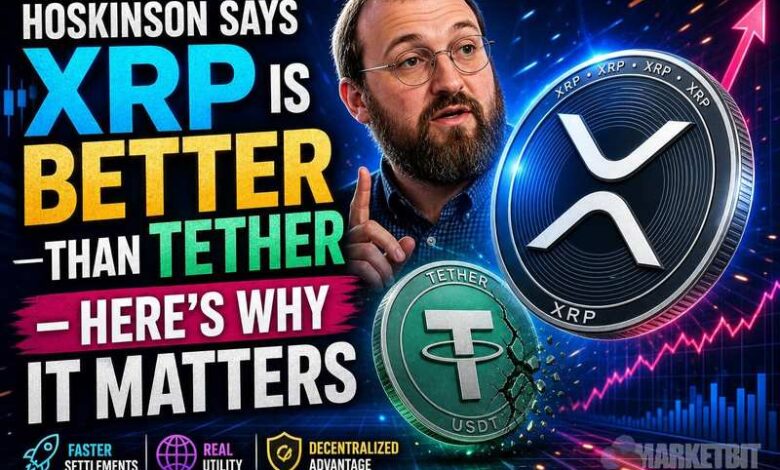
Cardano founder Charles Hoskinson declared on May 26 that XRP is a better product than Tether or Circle, praising the XRP Ledger’s open, permissionless design in a statement that marks a notable shift from his earlier criticism of Ripple’s value-accrual model.
“I think XRP as a Web2.5 product is better than Tether or Circle. I like it a lot more,” Hoskinson said in a clip shared by the @angrycryptoshow account on X. The statement was independently reported by multiple crypto outlets on the same day.
JUST IN: #Cardano $ADA Founder Charles Hoskinson says "I think $XRP as a Web2.5 product is better than Tether or Circle. I like it a lot more." pic.twitter.com/IAA2iedc5t
— Angry Crypto Show (@angrycryptoshow) May 26, 2026
Source: @angrycryptoshow on X
Hoskinson’s Case: Open Protocols Over Centralized Stablecoins
Hoskinson’s argument centers on permissionless access. He contrasted XRP Ledger’s open architecture with Tether and Circle, which can freeze funds and blacklist addresses at will. “I believe in open standards, open protocols, and open ecosystems,” he stated.
He specifically cited the ability to build without gatekeepers: “I don’t have to ask permission from Ripple to go and use XRPL.” That distinction, in Hoskinson’s framing, makes XRP fundamentally different from centralized stablecoins regardless of market size.
The comparison is notable given that Hoskinson leads Cardano, a competing Layer 1 blockchain. His willingness to publicly praise a rival project’s infrastructure lends the statement additional weight, though readers should weigh it knowing he has a history of shifting positions on XRP.
A Reversal From April’s Criticism
Just weeks earlier, in April 2026, Hoskinson had used Tether as a negative comparison for XRP, not a positive one. He argued that Ripple’s model keeps value at the company level and that XRP holders see no share of Ripple’s profits, similar to how Tether’s profits flow to its executives rather than USDT holders.
The two statements are not contradictory when read carefully. In April, Hoskinson criticized XRP’s value-accrual structure. In May, he praised XRP’s open-protocol design. His view of XRP versus Tether has two distinct dimensions: open access (where XRP wins, in his view) versus holder economics (where XRP loses). No competing coverage has surfaced this tension in a single article.
This nuance matters for investors evaluating the headline. Hoskinson is not making a blanket endorsement of XRP as an investment; he is praising a specific architectural property while maintaining separate reservations about Ripple’s business model.
Market Context: XRP and Tether by the Numbers
At the time of Hoskinson’s statement, XRP traded at $1.34, down 1.42% over 24 hours, with a market cap of $82.9 billion. Tether’s USDT, the asset Hoskinson compared unfavorably to XRP, commands a market cap of $189.4 billion with 189.6 billion tokens in circulation.
Tether’s market cap is more than double XRP’s, underscoring that Hoskinson’s comparison is philosophical rather than scale-based. He is not arguing XRP is bigger or more widely used; he is arguing its underlying design is more aligned with crypto’s original ethos of open access.
The broader crypto market sits in a fear phase, with the Fear & Greed Index at 34. Hoskinson’s cross-project praise arrives at a moment when sentiment is cautious and investors are scrutinizing fundamentals rather than chasing momentum.
The Stablecoin Debate Gets Louder
Hoskinson’s remarks land amid growing regulatory attention on stablecoins. He referenced Ripple CEO Brad Garlinghouse’s lobbying for crypto market structure rules that would treat most new projects as securities by default, potentially benefiting established assets like XRP, BTC, ETH, and ADA.
That regulatory backdrop adds a political dimension to his open-protocol argument. If centralized stablecoins like Tether’s planned GELT stablecoin thrive under restrictive frameworks, permissionless alternatives become more valuable as a counterweight. Hoskinson is positioning XRP Ledger’s design as a hedge against a future where compliance requirements entrench centralized issuers.
The stablecoin question also intersects with broader institutional adoption. BlackRock CEO Larry Fink’s recent comments about crypto serving a role comparable to gold suggest that traditional finance is increasingly comfortable with digital assets, but primarily those with clear regulatory standing.
Cardano’s own token, ADA, trades at $0.24 with a market cap of $8.95 billion, a fraction of XRP’s valuation. That gap may partly explain why Hoskinson is willing to praise XRP’s infrastructure: Cardano competes more directly with Ethereum than with XRP’s payment-focused use case.
For traders and developers watching the evolving landscape of crypto infrastructure, Hoskinson’s statement highlights a growing divide in how the industry evaluates digital assets. The question is no longer just price performance or market cap; it is whether the underlying protocol is open enough to survive the next wave of regulation without losing the properties that make crypto distinct from traditional finance.
Disclaimer: This article is for informational purposes only and does not constitute financial or investment advice. Cryptocurrency and digital asset markets carry significant risk. Always do your own research before making decisions.