
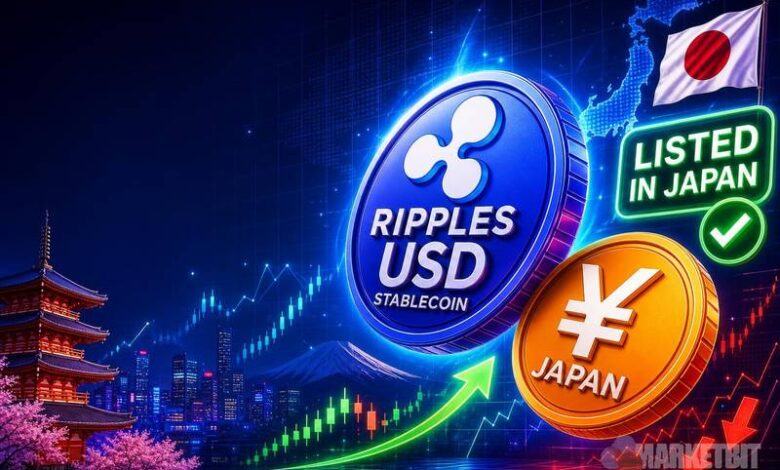
Ripple’s USD stablecoin has been listed in Japan, expanding the company’s stablecoin footprint into one of Asia’s most regulated cryptocurrency markets.
Ripple’s Stablecoin Reaches Japan
The listing introduces Ripple’s USD-pegged stablecoin, known as RLUSD, to Japanese traders and institutions. Japan has long maintained one of the world’s stricter regulatory frameworks for digital assets, making any new stablecoin listing in the country a notable development.
RLUSD is designed to maintain a 1:1 peg with the US dollar. The token launched as part of Ripple’s broader push beyond its core XRP payments infrastructure, and gaining access to the Japanese market represents a distribution milestone for the asset.
Ripple has been building its global presence steadily. The company recently expanded its regional headquarters in Dubai, signaling ambitions well beyond US borders. The Japan listing fits that pattern of geographic diversification.
Why Japan Matters for Ripple’s Stablecoin Strategy
Japan’s Financial Services Agency (FSA) oversees crypto exchanges with requirements that make listings more difficult to secure than in less regulated jurisdictions. A listing there carries implicit regulatory credibility that listings in permissive markets do not.
For RLUSD specifically, Japan offers access to a market with established crypto trading volume and institutional participation. The stablecoin has already received external validation, with Deloitte recently validating RLUSD in what was seen as a credibility boost for the asset.
Ripple also secured conditional approval for a national trust bank in the United States, suggesting the company is pursuing regulated financial infrastructure on multiple fronts simultaneously.
The stablecoin market is increasingly competitive. Tether’s USDT and Circle’s USDC dominate global volume, and newer entrants need strong distribution networks to gain traction. The total stablecoin supply tracked by DeFiLlama reflects this growing market, and a presence on Japanese exchanges gives RLUSD access to trading pairs and liquidity pools where dollar-denominated stablecoins serve as key on-ramps.
Stablecoin Expansion in Regulated Asian Markets
The listing arrives as stablecoins continue expanding across regulated markets in Asia. Japan, South Korea, and Singapore have each developed distinct regulatory approaches to stablecoins, and exchange listings in these jurisdictions often require compliance with local reserve and disclosure standards.
For Japanese users, a locally listed USD stablecoin provides a mechanism to hold dollar-pegged value and access dollar-denominated trading pairs without leaving domestic exchange infrastructure. This has practical implications for both retail traders and institutions managing cross-border settlement.
Ripple’s earlier work on the XRP Ledger stablecoin testing laid technical groundwork for RLUSD’s broader rollout. The Japan listing suggests that testing phase has translated into real market deployment.
XRP, the token most closely associated with Ripple, continues to maintain significant market capitalization and trading volume, providing a foundation of market attention that could benefit RLUSD adoption in Japan. The dynamics around XRP-related exchange pair changes underscore how Ripple’s ecosystem continues to evolve across both its legacy token and newer stablecoin product.
Whether RLUSD can capture meaningful market share in Japan will depend on exchange integration depth, trading pair availability, and how effectively Ripple leverages its existing relationships with Japanese financial institutions, a market where the company has historically maintained strong ties.
Disclaimer: This article is for informational purposes only and does not constitute financial or investment advice. Cryptocurrency and digital asset markets carry significant risk. Always do your own research before making decisions.