
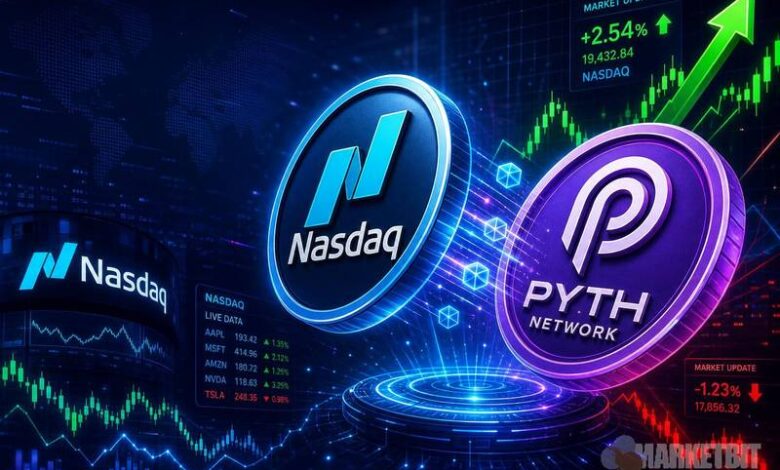
Nasdaq is bringing its flagship TotalView equity data feed to blockchain infrastructure through the Pyth Network, marking what Pyth calls the first time an onchain network has distributed Nasdaq’s market data.
Pyth announced on June 30, 2026 that Nasdaq is joining the Pyth Data Marketplace as a data publisher. The initial integration centers on Nasdaq TotalView, a depth-of-book feed that displays every quote and order at every price level for Nasdaq-, NYSE-, NYSE American- and regional-listed securities trading on Nasdaq. For related coverage, see UK Crypto Regulations Unveiled as Stablecoin Capital Rules Ease.
TotalView is not a basic price ticker. Nasdaq’s own product documentation states the feed provides more than 20x the liquidity of Level 2, covering full order-book depth plus the Net Order Imbalance Indicator (NOII) used during Nasdaq’s Opening and Closing Crosses and IPO/Halt Cross auctions.
According to the Business Wire release, Nasdaq will publish TotalView through Pyth’s global distribution layer to broaden access for onchain users and institutions. Mike Cahill said financial data is moving toward a model that is “more direct, programmable, and easier to integrate.”
CoinDesk independently confirmed the partnership, framing it in the context of financial firms building blockchain-based trading and settlement applications that require reliable external data.
Why deep order-book data matters onchain
Most blockchain oracles today relay top-of-book price feeds. TotalView’s full depth-of-book and auction imbalance data represents a qualitatively different input, one that could support more sophisticated execution models, risk engines, and market-structure analytics running on smart contracts.
For DeFi protocols and onchain trading platforms, access to granular equity market data opens potential use cases around tokenized equities, cross-market hedging, and institutional-grade order routing. The move follows a broader pattern of traditional finance infrastructure connecting to crypto rails, similar to how Binance recently listed tokenized Microsoft and Meta stocks to bridge equity exposure into crypto venues.
Reliable institutional data feeds also matter for the growing segment of protocols that depend on accurate external inputs. Faulty or shallow oracle data has historically been a vector for exploits, making the quality of the underlying feed a practical security concern, not just a feature upgrade.
The partnership arrives during a period of accelerating institutional integration between traditional finance and crypto infrastructure, with regulated entities increasingly choosing blockchain-native distribution channels over legacy data terminals.
Market reaction and what to watch next
PYTH, the native token of the Pyth Network, was trading at approximately $0.038 at press time, up roughly 6.1% over the prior 24 hours. The token’s market cap stood near $302 million with 24-hour trading volume around $63.8 million.
The broader crypto market remained cautious. The Fear & Greed Index sat at 15, firmly in “Extreme Fear” territory, suggesting the announcement landed against a risk-off backdrop rather than a momentum-driven rally.
Several open questions remain. The announcement does not detail which specific onchain destinations will receive TotalView data first, what the access and licensing model will look like for DeFi developers, or whether additional Nasdaq data products will follow. Builders working on onchain credit and financial primitives may be among the first to explore integration.
The concrete signal to watch is whether institutional trading desks and DeFi protocols begin consuming TotalView data through Pyth in production, rather than treating it as a proof of concept. Infrastructure reliability will also be a test, as any distribution layer handling exchange-grade data faces scrutiny on latency and uptime, concerns that echo the block production issues recently seen on other networks.
For now, the partnership establishes a concrete link between one of the world’s largest equity exchanges and onchain data infrastructure, setting a precedent that other exchanges and data vendors will likely be measured against.
Disclaimer: This article is for informational purposes only and does not constitute financial or investment advice. Cryptocurrency and digital asset markets carry significant risk. Always do your own research before making decisions.