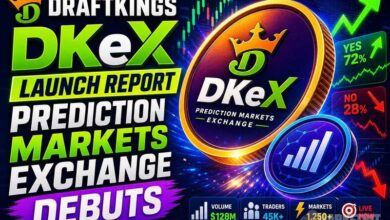

DraftKings has launched a proprietary prediction markets exchange, moving to build and control its own in-house platform for event-driven trading rather than relying on third-party infrastructure.
The company announced the launch on June 24, 2026, describing the new exchange as a way to bolster its “differentiated predictions experience.” The move signals that DraftKings views prediction markets as a standalone product line worth owning end-to-end, not just a feature layered on top of its existing sportsbook. For related coverage, see Cecabank Launches Crypto Custody Service With Renta 4 Banco.
What a Proprietary Prediction Markets Exchange Means
WHAT TO KNOW
- What: DraftKings launched its own prediction markets exchange, a platform where users trade contracts tied to real-world event outcomes.
- Why it matters: Building a proprietary exchange gives DraftKings direct control over pricing, liquidity, and the user experience.
- Context: Prediction markets have seen surging consumer interest, with consumer volume exceeding $3 billion on DraftKings’ predictions product.
A prediction markets exchange lets users buy and sell contracts that pay out based on the outcome of future events. These events can range from elections and economic data releases to sports outcomes and cultural milestones. Contracts typically trade between $0 and $1, with the price reflecting the market’s implied probability of that outcome occurring.
The word “proprietary” is key. Rather than white-labeling someone else’s exchange technology or routing orders through an external matching engine, DraftKings built its own. This gives the company control over the order book, fee structure, settlement logic, and user interface, all elements that shape how traders interact with the product.
DraftKings had previously been expanding into federally regulated prediction markets, and this launch represents the infrastructure buildout to support that expansion.
How the Exchange Differs From Traditional Sports Betting
Standard sportsbook products offer fixed odds set by the operator. A user places a bet, and the house takes the other side. In a prediction markets exchange, users trade directly with each other. Prices move continuously as new information arrives, and participants can exit positions before the event resolves.
This exchange model is closer to financial trading than traditional gambling. Users see real-time pricing that reflects aggregate market sentiment, can manage risk by selling contracts mid-event, and face market-driven spreads rather than operator-set margins. For audiences already familiar with trading platforms, the mechanics are intuitive.
It is worth distinguishing this from the broader DraftKings DKeX launch reporting, which covered the initial product debut. The proprietary exchange announcement represents the underlying infrastructure shift powering that experience.
Why DraftKings Is Building In-House
Owning the exchange technology gives DraftKings several strategic advantages. It eliminates dependency on third-party exchange providers, allows tighter integration with its existing user base and mobile app ecosystem, and positions the company to capture both trading fees and the data generated by order flow.
The timing aligns with a broader surge in prediction market activity. Platforms like Polymarket have demonstrated that event-driven trading attracts a user base that overlaps with, but is distinct from, traditional sports bettors. Polymarket’s revenue trajectory toward $1 billion has underscored the commercial viability of the category, giving DraftKings a clear incentive to compete with owned infrastructure.
Prediction markets also sit at the intersection of trading and speculation that appeals to digital-asset-native audiences. The exchange model, with its real-time pricing, order books, and settlement mechanics, shares structural similarities with derivatives products launching on regulated venues like CME.
For DraftKings, the open question is execution: whether its existing user base will adopt exchange-style trading, and whether evolving regulatory frameworks for prediction markets will support or constrain growth. The company has not disclosed specific fee structures, available event categories, or jurisdictional availability for the new exchange.
Disclaimer: This article is for informational purposes only and does not constitute financial or investment advice. Cryptocurrency and digital asset markets carry significant risk. Always do your own research before making decisions.