


eToro’s first-quarter crypto revenue dropped to $2.15 billion from $3.5 billion a year earlier, a 38.5% decline that underscores how sharply retail crypto trading activity has cooled even as the platform’s overall profitability improved on the back of a commodities surge.
Crypto revenue fell 38% while profits rose
The company’s Q1 2026 filing showed revenue from cryptoassets of $2,153,099 thousand, compared with $3,500,800 thousand in Q1 2025. Total revenue and income also declined, falling to $2.44 billion from $3.76 billion over the same period.
The crypto segment’s cost structure made the revenue decline even more notable. Cost of revenue from cryptoassets reached $2.17 billion against the $2.15 billion in crypto revenue, leaving the segment with virtually no gross margin for the quarter.
Yet eToro’s bottom line moved in the opposite direction. Net contribution rose to $258.1 million from $217.1 million a year earlier, and net income climbed to $82.4 million from $60.0 million. The divergence points to a deliberate shift in the platform’s revenue mix away from crypto toward higher-margin asset classes.
Commodities filled the gap as crypto trading shrank
eToro said commodities trading accounted for approximately 60% of trading commissions in Q1 2026, with commodities volumes increasing nearly fourfold versus the prior year. That expansion more than offset the crypto slowdown at the profitability level, a pattern that mirrors how traditional financial institutions have diversified their digital asset strategies.
The weakness in crypto extended into April. eToro disclosed that April 2026 crypto activity totaled 2.0 million trades, down 32% year over year. The average invested amount per crypto trade fell 22% to $207, suggesting both fewer participants and smaller position sizes.
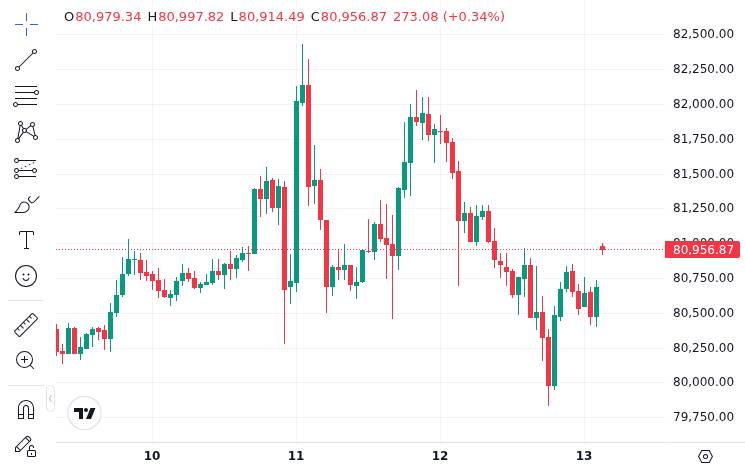
Bitcoin traded near $80,996 at press time, modestly negative over the past 24 hours. The broader crypto Fear & Greed Index sat at 42, in “Fear” territory, reflecting the cautious environment that has weighed on platforms like eToro whose crypto revenue depends on active retail trading.
Regulatory expansion continues despite the revenue dip
eToro used the same quarterly release to highlight regulatory milestones. The company activated its BitLicense and Money Transmitter License, allowing New York users to trade 13 digital assets. It also obtained a MiCA permit from CySEC in February 2026, giving it a regulated pathway to provide crypto services across the European Union.
Those licensing wins position eToro to capture volume if retail crypto appetite recovers, but for now the numbers tell a story of contraction. The decline in per-trade size and trade count echoes a broader pattern visible across the industry, where firms like Bitdeer have also reported softening output metrics and stablecoin-focused startups are attracting capital as alternatives to volatile trading revenue.
Wall Street shrugged off the crypto decline
Despite the sharp drop in crypto revenue, ETOR shares edged up 1.19% in premarket trading after the report. Investors appeared to reward the profit beat and the commodities pivot rather than penalizing the crypto weakness.
The market reaction suggests that, at least for now, eToro’s diversification strategy is buying it credibility with equity investors even as the crypto side of its business contracts. Whether that trade-off holds depends on how long the current downturn in retail crypto engagement persists and whether the company’s newly licensed markets in New York and the EU can generate meaningful volume.
Disclaimer: This article is for informational purposes only and does not constitute financial or investment advice. Cryptocurrency and digital asset markets carry significant risk. Always do your own research before making decisions.