Vitalik Buterin declared that once Lean Ethereum reaches full deployment, Ethereum will stand alone among major blockchains as the only one combining theoretically optimal security under synchrony with strong economic finality under asynchrony. The bold claim ties directly to a multi-year upgrade vision first outlined by the Ethereum Foundation in mid-2025.
What Vitalik Buterin Said About Lean Ethereum
In a March 18, 2026 post on X, Buterin wrote that Lean Ethereum would make ETH "the only major chain that simultaneously has (i) theoretically optimal security properties under synchrony and (ii) strong economic finality under asynchrony."
Once @leanethereum is fully deployed, Ethereum will be the only major chain that simultaneously has (i) theoretically optimal security properties under synchrony [requires 51% of online validators honest], and (ii) strong economic finality under asynchrony. Most "semi-centralized…
— vitalik.eth (@VitalikButerin) March 18, 2026
Source: @VitalikButerin on X
What to Know
- The claim: Vitalik Buterin says Lean Ethereum would give ETH a unique dual advantage, optimal security under synchrony and strong economic finality under asynchrony, that no other major chain currently offers.
- The origin: Lean Ethereum was introduced as a 10-year vision by Ethereum Foundation researcher Justin Drake in a July 31, 2025 blog post proposing upgrades across three L1 sublayers.
- The condition: This outcome depends entirely on Lean Ethereum being fully deployed, a process that spans consensus, data availability, and execution layers.
The distinction Buterin draws rests on two technical properties. Synchrony security means the chain remains safe as long as at least 51% of online validators are honest. Asynchronous economic finality means transactions become irreversible even if network timing assumptions break down, backed by real economic stakes.
Buterin's framing positions these as complementary guarantees that, taken together, would set Ethereum apart from chains that offer one but not both.
Why Lean Ethereum Could Strengthen ETH's Position
The Lean Ethereum vision was formally laid out by Justin Drake in an Ethereum Foundation blog post published July 31, 2025. Drake described it as his personal mission for Ethereum's next decade, proposing upgrades across all three L1 sublayers: lean consensus, lean data, and lean execution.
On the performance side, the plan sets ambitious longer-term targets: 1 gigagas per second on L1, described as roughly 10,000 transactions per second, and 1 teragas per second on L2, roughly 10 million TPS. These numbers represent an order-of-magnitude leap from current throughput.
A separate Ethereum Foundation roadmap post from March 23, 2026 provides additional context on how L1 and L2 now relate. According to that document, L2s are primarily for differentiated features, control, and innovation, while L1 remains the permissionless hub for settlement, liquidity, and DeFi.
The same roadmap noted that blobs, the data availability mechanism used by L2 rollups, are currently only about 30% full. That headroom suggests the network can absorb significant additional L2 growth before capacity becomes a bottleneck.
The Ethereum Foundation's roadmap also stated that Ethereum offers reputational and regulatory-acceptance benefits to chains building within its ecosystem. While other blockchain ecosystems compete on speed or cost, the Lean Ethereum thesis argues that security guarantees are the more durable moat, a narrative that contrasts with how regulators have approached classification of other major tokens like XRP.
At press time, ETH traded at $2,139.90, up 4.08% over the prior 24 hours, with a market cap of $257.85 billion and 24-hour trading volume near $21.6 billion.
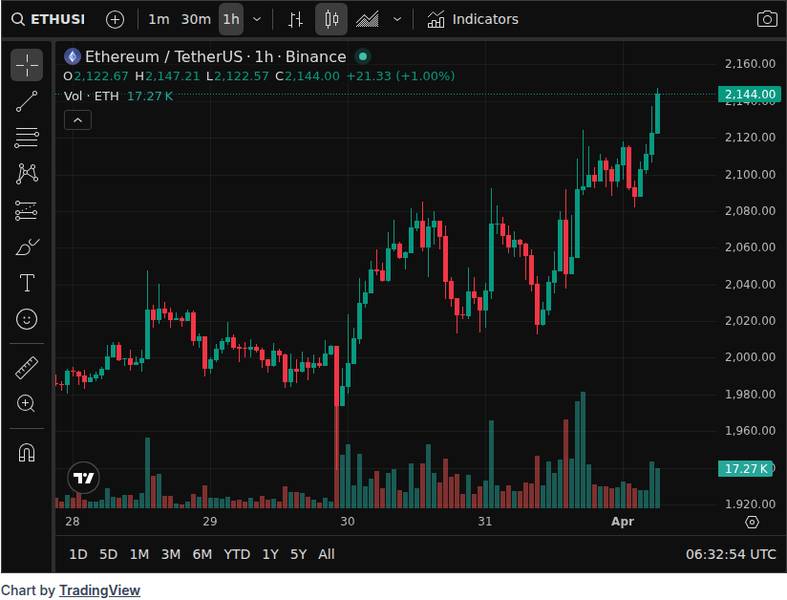
The broader crypto market remains cautious. The Fear & Greed Index sat at 8, deep in "Extreme Fear" territory, reflecting macro uncertainty that has weighed on sentiment across digital assets, including recent whale-driven volatility in BTC, SHIB, and XRP.
What Full Deployment Could Mean for Ethereum Next
If Lean Ethereum delivers on its stated goals, Ethereum's L1 would handle throughput comparable to centralized systems while retaining the security properties Buterin highlighted. The three-sublayer upgrade path, covering consensus, data, and execution, means deployment is not a single event but a sequence of milestones spread across years.
Execution risk is the core variable. Drake's original post framed Lean Ethereum as a decade-long effort, which means the dual-guarantee advantage Buterin described is not imminent. Each sublayer upgrade must ship, stabilize, and prove itself under real network conditions before the full vision materializes.
The current state of the network offers some early signals. With blobs at roughly 30% utilization, Ethereum has room to scale L2 activity without immediate pressure on data availability. The L1/L2 division of labor described in the March 2026 roadmap, where L1 handles settlement and DeFi while L2s handle experimentation, provides a framework for how Lean Ethereum upgrades would slot into a live, production network.
Ethereum's DeFi ecosystem, which the Ethereum Foundation roadmap positions as a core L1 function, would benefit most directly from the execution-layer improvements. Higher L1 throughput could reduce gas costs for on-chain DeFi without requiring users to migrate to L2s, potentially strengthening Ethereum's settlement-layer dominance at a time when rival payment rail integrations are expanding across competing ecosystems.
For now, Buterin's claim is a forward-looking assertion, not a delivered result. The gap between Lean Ethereum's vision and its deployment will determine whether ETH actually achieves the unique dual-guarantee status he described. The Ethereum Foundation's willingness to publish detailed roadmaps and performance targets gives outside observers concrete benchmarks to track, but the timeline remains measured in years, not quarters.
Disclaimer: This article is for informational purposes only and does not constitute financial or investment advice. Cryptocurrency and digital asset markets carry significant risk. Always do your own research before making decisions.