

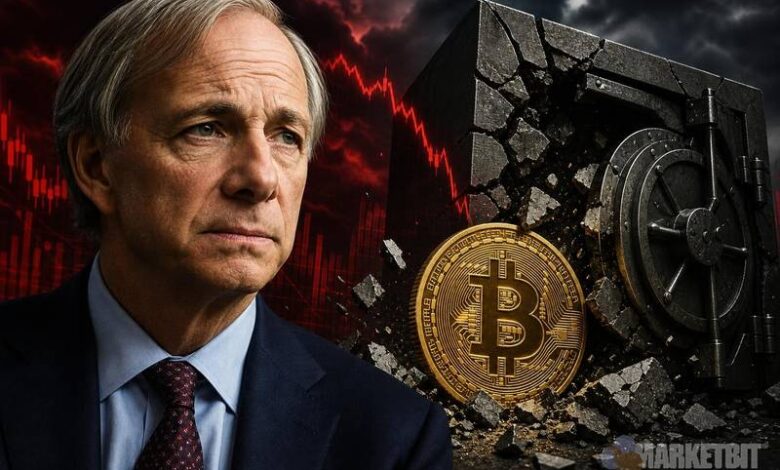
Ray Dalio, founder of Bridgewater Associates and one of the most influential investors in modern finance, has publicly stated that Bitcoin fails as a safe-haven asset. The remark challenges one of Bitcoin’s core investment theses and has reignited debate over the cryptocurrency’s role during periods of economic stress.
Why Ray Dalio Says Bitcoin Failed the Safe-Haven Test
Dalio’s position, reported by Cointelegraph, centers on the idea that Bitcoin has not behaved like traditional safe-haven assets during market downturns. A safe haven, in market terms, is an asset that holds or gains value when equities and riskier investments fall.
Gold is the classic example. Investors flee to gold during recessions, geopolitical crises, and currency devaluations because it has centuries of track record as a store of value. Dalio’s argument is that Bitcoin, despite being marketed as “digital gold,” has not demonstrated that same reliability when markets come under pressure.
The claim is attribution-driven: Dalio is not presenting new data but offering his assessment based on how Bitcoin has traded relative to risk assets. As Yahoo Finance reported, Dalio has drawn a clear line between Bitcoin and gold, suggesting the two should not be compared as equivalent hedges.
What the Comment Means for Bitcoin’s Safe-Haven Narrative
Bitcoin’s store-of-value narrative has been central to institutional adoption arguments for years. Proponents have positioned it as a hedge against inflation, currency debasement, and systemic financial risk, often drawing direct comparisons to gold.
Dalio’s comment strikes at that framing directly. If Bitcoin does not hold value during the exact stress periods when investors need a hedge most, the “digital gold” label becomes a marketing story rather than a functional description.
This matters because institutional allocators weigh safe-haven characteristics when deciding portfolio exposure. A Bitcoin that behaves like a high-beta tech stock during sell-offs serves a different portfolio function than one that acts as a defensive anchor. The distinction shapes how much capital large funds are willing to commit.
The debate is not new, but Dalio’s stature gives it renewed weight. His views on debt cycles, monetary policy, and macro risk carry influence across both traditional finance and crypto-adjacent investment circles, similar to how prominent figures reshaping project governance can shift market perception overnight.
Why Traders and Investors May Watch This Headline Closely
Commentary from well-known investors can move market discussion even without introducing new price data or on-chain metrics. Dalio’s remarks are likely to surface in analyst notes, trading desk commentary, and social media debate, all of which feed into short-term sentiment.
The key distinction for traders is between sentiment impact and actual price action. A negative safe-haven framing from a respected macro investor can dampen enthusiasm and shift narrative momentum, but it does not by itself trigger sell pressure or invalidate Bitcoin’s other use cases.
Bitcoin continues to trade in an environment shaped by multiple competing narratives, from ETF-driven institutional demand to evolving blockchain infrastructure across the broader crypto ecosystem. Even headline-driven events like protocol exploits in DeFi can temporarily overshadow macro commentary.
The measured takeaway is that Dalio’s view adds a credible voice to an ongoing debate but does not settle it. Bitcoin’s safe-haven case will ultimately be tested by how it performs during the next sustained period of financial stress, not by any single investor’s opinion.
Disclaimer: This article is for informational purposes only and does not constitute financial or investment advice. Cryptocurrency and digital asset markets carry significant risk. Always do your own research before making decisions.