
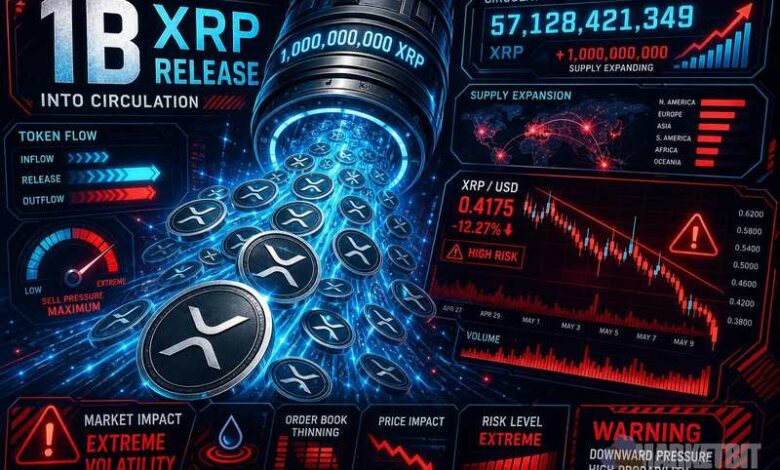
Ripple released 1 billion XRP from escrow, renewing attention on the token’s supply dynamics and how the periodic unlock process affects market sentiment.
What happened in Ripple’s 1 billion XRP release
Blockchain tracking service Whale Alert flagged the movement of 1 billion XRP from Ripple’s escrow wallets, a transaction visible on-chain through Whale Alert’s transaction tracker.
Ripple’s escrow system was established in 2017, when the company locked 55 billion XRP into a series of cryptographic escrow accounts. Each month, up to 1 billion XRP becomes eligible for release. Tokens that Ripple does not use are typically returned to escrow at the end of the cycle.
WHAT TO KNOW
- Size: 1 billion XRP unlocked from escrow
- Source: Ripple’s programmatic monthly escrow release
- Significance: Released tokens are not the same as tokens entering open-market circulation; Ripple frequently relocks a portion
The distinction between “released” and “sold” is critical. When tokens leave escrow, they move to Ripple-controlled wallets. From there, the company decides how many to deploy for operational purposes, institutional sales, or partnerships, and how many to return to new escrow contracts. Reporting from U.Today has tracked how many XRP remain in escrow after successive monthly events.
Why the XRP supply move matters to the market
A 1 billion XRP release draws scrutiny because of supply overhang concerns. Traders monitor whether Ripple sends large portions of unlocked tokens to exchanges, which could increase sell pressure on the open market.
The monthly escrow unlock is a scheduled, predictable event. Veteran XRP holders treat it as routine, while newer market participants sometimes interpret the headline as a sudden supply shock. The reality sits between these views: the release creates the potential for increased circulating supply, but Ripple’s historical pattern has been to rlock a significant share.
In the broader altcoin market, supply-side events have drawn increased attention. Separate developments, such as the record outflows tracked on major Bitcoin ETFs, show that institutional flow data across crypto assets is becoming a key driver of sentiment. Readers tracking large capital movements may also note how BlackRock’s Bitcoin ETF recorded a $1.41 billion net outflow in May, illustrating the weight that fund flows carry across the digital asset space.
What to watch next for XRP after the release
The most immediate signal to monitor is wallet activity in the days following the unlock. Observers using tools like AllAboutXRP’s escrow tracker can see whether Ripple relocks the majority of the released tokens or retains them in operational wallets.
Exchange inflow data is the second key indicator. If large XRP deposits appear on major trading platforms shortly after the release, that would suggest Ripple or related entities are positioning tokens for potential sale. Absence of such transfers would point toward the tokens being held or relocked.
Security across the broader crypto ecosystem remains a relevant concern for holders evaluating risk. Recent incidents, including a case where fake bridge messages allowed a hacker to drain funds, underscore the importance of verifying transaction authenticity, particularly when large token movements generate headlines.
Investors weighing their positioning amid large supply events may find perspective in how other market participants approach volatility. Robert Kiyosaki recently urged investors to think strategically during corrections, a reminder that supply-driven price swings often look different in hindsight than they do in real time.
The next monthly escrow unlock will provide the next comparable data point. Until then, on-chain wallet movements and exchange transfer volumes remain the most reliable indicators of whether this release translates into meaningful selling pressure.
Disclaimer: This article is for informational purposes only and does not constitute financial or investment advice. Cryptocurrency and digital asset markets carry significant risk. Always do your own research before making decisions.