


Tether and the Government of Georgia have announced plans to launch GEL₮ (GELT), a stablecoin pegged to the Georgian lari, marking one of the first sovereign-government-backed private stablecoin partnerships in the crypto industry. The announcement, made on May 25, 2026, involves Tether, Georgia’s National Bank, and the Parliament of Georgia.
Tether and Georgia Plan GELT Stablecoin
GEL₮ will be pegged 1:1 to the Georgian lari (GEL), though specific details about blockchain networks, reserve banking partners, and an exact launch date have not yet been disclosed. The partnership builds on a memorandum of understanding signed in 2023 between Tether and Georgia’s government to support Bitcoin, Web3, and peer-to-peer technology development in the country.
Georgia already permits tax payments via instant conversion of digital assets into local currency, an unusual policy among sovereign nations that signals a regulatory environment primed for stablecoin adoption.
Tether CEO Paolo Ardoino framed the move as part of a broader infrastructure shift in global finance.
“Stablecoins are no longer a niche financial instrument. They are becoming part of the infrastructure layer for global finance. Georgia has moved early to create serious regulatory architecture for digital assets and stablecoins, and that clarity creates the foundation for real innovation and adoption.”
— Paolo Ardoino, CEO of Tether
Georgian Prime Minister Irakli Kobakhidze stated that “together with visionary partners like Tether, Georgia is laying the foundations for a more connected, transparent, and digitally empowered financial world.”
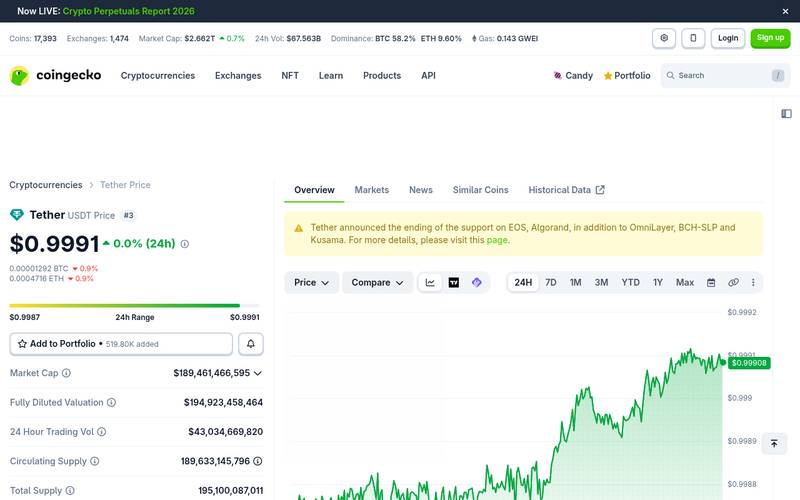
Tether’s USDT currently commands a market cap approaching $190 billion, with daily trading volume that regularly surpasses Visa and Mastercard combined.
Why a Government-Backed Stablecoin Matters for Tether
GELT represents an evolution in Tether’s product strategy beyond USDT. The company has been systematically building sovereign currency stablecoins: it launched MXNT (pegged to the Mexican peso) in 2022, which remains active. Its euro-pegged EURT was discontinued in November 2025, and Tether recently introduced USAT for the US market following passage of the GENIUS Act.
Georgia is Tether’s most government-integrated deployment to date. Unlike MXNT, which operates as a private-market product, GELT involves direct coordination with a national bank and parliament. The pattern suggests Tether is developing a systematic playbook for sovereign currency digitization.
Georgia’s National Bank approved stablecoin issuance rules in March 2026, creating a framework explicitly designed for compatibility with the US GENIUS Act, the EU’s MiCA regulation, and Dubai’s VARA rules. The framework covers reserve management, redemption rights, issuer oversight, and AML compliance.
This cross-jurisdictional alignment positions Georgia as an early test case for how smaller nations can integrate private stablecoin infrastructure within globally recognized regulatory standards. In a crypto environment where governments have taken increasingly varied stances on digital asset platforms, Georgia’s full-embrace model stands out.
The broader stablecoin market provides context for the timing. On-chain stablecoin volume reached $7.6 trillion in April 2026, with projections from Ripple suggesting the market could hit $33 trillion for the full year. For Georgia, a country of 3.7 million people, a lari-pegged stablecoin could streamline cross-border payments that currently rely on traditional banking rails.
According to unconfirmed secondary reporting, remittances account for over 10% of Georgia’s GDP, primarily from Russia, Greece, and the United States. If accurate, this would make GEL₮ particularly relevant for inbound payment flows.
What to Watch as the GELT Story Develops
Despite the high-level announcement, several critical implementation details are missing. No specific blockchain networks have been confirmed for GEL₮ issuance. According to unconfirmed reports, GEL₮ may launch on multiple chains, but the official announcement does not specify this.
Reserve banking partners and redemption mechanics have not been announced. Given Tether’s history of scrutiny over reserve transparency, similar to how initial reports can diverge from confirmed details in crypto, the structure of GEL₮’s backing will likely face close examination from both the crypto community and Georgian regulators.
Tether’s track record with non-USD stablecoins is mixed. MXNT remains active since its 2022 launch, but EURT’s discontinuation in November 2025 demonstrates that not every sovereign currency stablecoin finds sufficient demand. Whether Georgia’s relatively small economy can sustain adoption will depend heavily on remittance use cases and government integration.
The Crypto Fear & Greed Index sat at 30 (Fear) on the day of the announcement, suggesting broader market caution even as institutional stablecoin infrastructure continues to expand. Meanwhile, exchange-level adjustments to trading products suggest the industry continues restructuring regardless of short-term sentiment.
Traders and institutions should watch for announcements regarding blockchain deployment, reserve structure, and redemption mechanics. These details will determine whether GELT functions as a liquid financial instrument or remains a pilot project, and whether Tether’s sovereign stablecoin playbook can scale beyond individual partnerships into a broader model for currency digitization.
Disclaimer: This article is for informational purposes only and does not constitute financial or investment advice. Cryptocurrency and digital asset markets carry significant risk. Always do your own research before making decisions.