
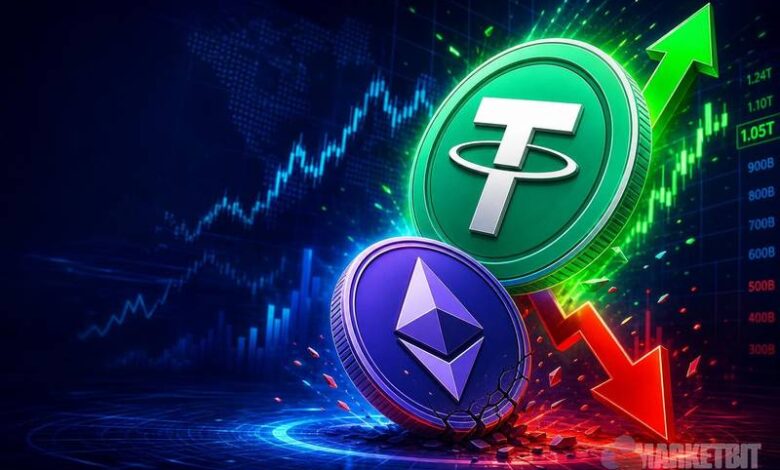
A growing number of market watchers are discussing the possibility that Tether’s USDT could overtake Ethereum in market capitalization, a shift that would mark the first time a stablecoin outranks the second-largest cryptocurrency by market value.
The prediction has gained traction on social media and prediction markets. A Polymarket event page is tracking whether ETH will be “flipped” in 2026, giving traders a venue to wager on the outcome directly.
What to Know
- Some market participants predict USDT could surpass ETH in total market capitalization.
- USDT’s market cap grows through new token issuance, while ETH’s depends on its trading price.
- A flip would be symbolic, signaling that dollar-pegged liquidity outweighs the largest smart-contract platform by value.
Why This Comparison Matters to Traders
Ethereum has held the number-two spot in crypto market-cap rankings for years, sitting behind only Bitcoin. USDT, as the dominant dollar-pegged stablecoin, serves a fundamentally different role: it represents parked capital and trading liquidity rather than speculative exposure to a network’s future.
A scenario where USDT’s total supply value exceeds ETH’s market cap would suggest that the amount of dollar-equivalent liquidity circulating in crypto markets has grown faster than investor confidence in Ethereum’s price. Some analysts have explored the outlook for Tether’s market cap relative to major crypto assets, noting that sustained stablecoin issuance could narrow the gap.
The discussion comes at a time when institutional players are increasingly active in crypto. Developments like Morgan Stanley exploring bitcoin lending for spot crypto ETF conversions and Anchorage reportedly building a Wall Street-style crypto settlement network point to growing infrastructure around digital asset markets, infrastructure that relies heavily on stablecoin rails.
How the Gap Could Close
Market capitalization is calculated by multiplying circulating supply by current price. For USDT, the price is pegged near $1.00, so its market cap rises almost entirely through new token mints. Tether issues new USDT when demand for trading liquidity, cross-border transfers, or dollar exposure increases.
Ethereum’s market cap, by contrast, fluctuates with ETH’s trading price. A sustained decline in ETH’s price, or even a period of sideways movement while Tether continues issuing tokens, could bring the two closer together. Recent sovereign and institutional movements in crypto, such as Bhutan’s government transferring 738 BTC worth $44.88 million, illustrate how large holders can shift market dynamics quickly.
The gap can also narrow from both sides simultaneously. During risk-off periods, traders often rotate out of volatile assets like ETH and into stablecoins, which shrinks ETH’s market cap while expanding USDT’s.
What a Flip Would Signal
If USDT were to overtake ETH, it would carry more symbolic than structural significance. It would not change how either asset functions, but it would reshape how market participants interpret the state of the crypto market.
A larger USDT footprint relative to ETH could indicate that traders are prioritizing capital preservation and positioning over active exposure to smart-contract platforms. In past cycles, rising stablecoin dominance has coincided with periods of caution or consolidation.
Conversely, Ethereum’s market cap is often viewed as a barometer for confidence in the broader altcoin ecosystem. A declining ETH valuation relative to stablecoins could weigh on sentiment for tokens and protocols built on top of the Ethereum network.
For now, the prediction remains speculative. Market-cap rankings can shift rapidly during strong price moves in either direction, and no confirmed timeline exists for when or whether such a flip would occur. Traders watching this narrative will likely focus on Tether’s monthly attestation reports for supply growth and ETH’s price trajectory in the weeks ahead.
Disclaimer: This article is for informational purposes only and does not constitute financial or investment advice. Cryptocurrency and digital asset markets carry significant risk. Always do your own research before making decisions.