
XRP ETF Gets Only $640K in 24 Hours as Bitcoin and Ethereum ETFs Pull $155 Million

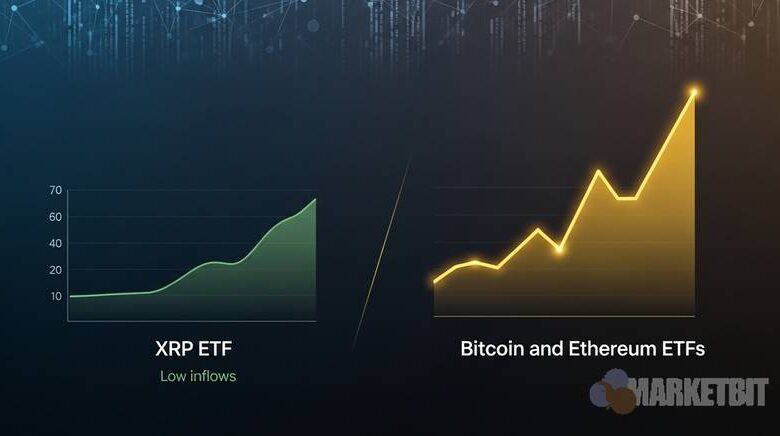
XRP spot ETFs pulled in a mere $640,000 during the week ending March 20, 2026, while Bitcoin and Ethereum ETFs collectively moved $155 million in the same period. The staggering 240x gap between XRP and its larger rivals has reignited debate over whether institutional investors see any near-term value in XRP exposure.
Source: U.Today · Week of March 16–20, 2026
XRP ETF Records $640,000 in Weekly Inflows as Seven Funds Struggle for Traction
Seven XRP spot ETFs are now live in the United States, including products from Canary, Franklin, 21Shares, Bitwise, and Grayscale. Together, they attracted just $640,000 in net inflows during the week of March 16–20.
That figure is not a rounding error. It represents the total new capital that flowed into all seven XRP ETF products combined over a full trading week. For context, Solana’s ETF attracted $21.10 million in the same period, roughly 33 times more than XRP.
Since launching in November 2025, XRP ETFs have accumulated approximately $1.24 billion in cumulative net inflows. But recent weeks suggest momentum is fading. On March 6, XRP ETFs recorded their largest single-day outflow of the month at $16.62 million.
XRP itself traded near $1.41 on March 23, down roughly 4% over the prior 24 hours. Its market cap sits around $86.5 billion, ranking it fifth among cryptocurrencies. The broader market mood is not helping: the Fear & Greed Index has plunged to 8, deep into “Extreme Fear” territory, a level that has historically coincided with sharp risk-off moves across altcoins.
Bitcoin and Ethereum ETFs Move $155 Million, Highlighting the Institutional Divide
Bitcoin spot ETFs recorded $95.18 million in net inflows during the same week. That marks four consecutive weeks of positive inflows for Bitcoin ETFs, a streak that underscores the asset’s role as the primary institutional entry point into crypto.
Ethereum spot ETFs, by contrast, saw $59.94 million in net outflows. Despite that negative reading, the absolute scale of Ethereum’s flows still dwarfs XRP’s. The combined $155 million in Bitcoin and Ethereum ETF activity (counting both inflows and outflows) puts XRP’s $640,000 in stark perspective.
The ratio is roughly 240 to 1. For every dollar that moved through XRP ETFs, $240 moved through the Bitcoin and Ethereum products. Even Solana, a newer entrant to the ETF market, attracted more than 30 times the capital that XRP did.
Bitcoin’s dominance in ETF flows reflects a pattern that has held since the first U.S. spot Bitcoin ETFs launched in January 2024. Institutional allocators have consistently treated Bitcoin as a macro hedge and portfolio diversifier, while Ethereum draws interest from funds with exposure mandates around DeFi and staking infrastructure.
What the Flow Gap Reveals About XRP’s Institutional Standing
The disparity raises a structural question: is XRP’s weak ETF performance a temporary slow start, or does it reflect a deeper lack of institutional conviction?
XRP’s path to ETF approval was uniquely complicated. Years of regulatory uncertainty stemming from Ripple’s legal battle with the SEC delayed institutional product development. While that chapter is largely closed, the residual effect may be lingering. Institutional allocators who sat on the sidelines during the litigation period have had little reason to rush in now, especially with Bitcoin offering a cleaner narrative and deeper liquidity.
Analysts at U.Today characterized XRP’s ETF inflows as “miniscule and irrelevant,” noting that “markets are driven by capital flows, and at the moment, XRP is not where the money is going.” The assessment is blunt but supported by the data.
One potential mitigating factor: altcoin ETFs have historically lagged Bitcoin ETF inflows at launch. Early performance is not always predictive of long-term demand. Bitcoin’s own ETF products saw significant variance in their first weeks before settling into more consistent flow patterns.
Still, the gap between XRP and even Solana complicates the “give it time” argument. Solana’s $21.10 million in weekly inflows suggests that when institutional capital does rotate into altcoins, it is favoring assets with stronger narratives around infrastructure, speed, and developer ecosystem growth. XRP lacks a comparable institutional story around DeFi or staking that has helped sustain Ethereum ETF interest.
The broader market environment adds further headwinds. With the Fear & Greed Index at 8 and Bitcoin miners redirecting resources amid shifting economics, risk appetite across the crypto sector remains suppressed. In that climate, capital tends to consolidate around the largest, most liquid assets, not spread into smaller ETF products.
XRP ETFs are not failing by every metric. The $1.24 billion in cumulative inflows since November represents real institutional adoption. But the weekly trend is pointing in the wrong direction, and until XRP can demonstrate a compelling reason for fund managers to allocate fresh capital, the gap between it and Bitcoin is likely to widen, not narrow.
Disclaimer: This article is for informational purposes only and does not constitute financial or investment advice. Cryptocurrency and digital asset markets carry significant risk. Always do your own research before making decisions.