

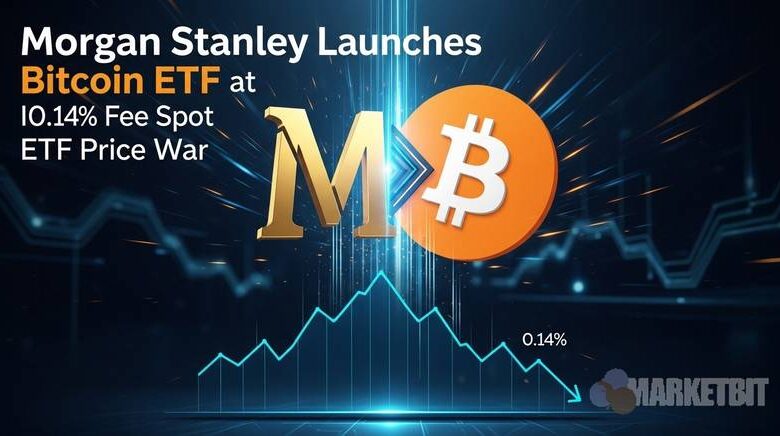
Morgan Stanley is preparing to launch a spot Bitcoin ETF with an expense ratio of 0.14%, undercutting every major rival in the U.S. market and setting the stage for an aggressive fee war among Wall Street’s biggest asset managers.
Morgan Stanley’s 0.14% Fee Undercuts BlackRock, Fidelity, and the Rest
The investment bank’s planned ETF would carry a 0.14% annual fee, positioning it as the cheapest spot Bitcoin ETF available to U.S. investors. That figure sits below the current fee leaders in the category, including BlackRock’s iShares Bitcoin Trust (IBIT) and Fidelity’s Wise Origin Bitcoin Fund (FBTC), both of which charge higher expense ratios.
The pricing move signals that Morgan Stanley views fee compression as the primary lever for capturing market share in an increasingly crowded field. Since the first wave of spot Bitcoin ETF approvals, issuers have steadily lowered costs to attract both retail and institutional capital, with some offering temporary fee waivers to build early assets under management.
Morgan Stanley’s entry at a record-low 0.14% removes the need for a waiver period entirely, offering a permanently competitive rate from day one.
What a Fee War Means for Bitcoin ETF Investors
The difference between a 0.14% and a 0.25% expense ratio may appear marginal, but it compounds meaningfully at scale. On a $100,000 Bitcoin ETF position held for one year, the gap translates to roughly $110 in annual savings. For institutional allocators deploying tens of millions, those basis points represent a material cost advantage.
Fee alone does not determine ETF quality. Liquidity, bid-ask spreads, and tracking accuracy all influence real-world investor returns. However, in a market where multiple issuers hold the same underlying asset, the expense ratio becomes one of the most straightforward differentiators.
Morgan Stanley also brings a distribution advantage that most competitors lack. The firm’s wealth management division oversees trillions in client assets, and its network of financial advisors can funnel allocations directly into the new product. That built-in pipeline could accelerate asset gathering in ways that standalone ETF issuers cannot replicate, similar to how sovereign holders have reshaped Bitcoin supply dynamics through large-scale positioning.
What Morgan Stanley’s Entry Signals for the Spot Bitcoin ETF Market
A major Wall Street bank pricing aggressively into the Bitcoin ETF space carries significance beyond the fee itself. It confirms that traditional financial institutions now treat spot Bitcoin ETFs as a permanent, competed-over product category, not an experiment.
The spot Bitcoin ETF market has grown substantially since the initial approvals, with cumulative assets under management across all issuers reaching tens of billions. Morgan Stanley’s decision to enter at this stage, rather than during the initial launch window, suggests the firm sees a long runway for continued inflows.
The competitive pressure could force existing issuers to respond with further fee reductions. In traditional equity ETF markets, fee wars in categories like S&P 500 index funds ultimately drove expense ratios toward zero, benefiting investors while consolidating market share among the largest providers. The broader digital asset landscape stands to benefit as lower costs remove one more barrier to mainstream adoption.
Whether rivals like BlackRock and Fidelity will match Morgan Stanley’s pricing remains an open question. Both firms have the scale to absorb lower margins, but cutting fees on products that have already attracted significant AUM directly reduces revenue. The coming weeks will reveal whether 0.14% becomes the new floor or simply one salvo in a longer pricing battle.
For Bitcoin’s positioning as a mainstream financial asset, Morgan Stanley’s move reinforces the trend. As institutions like Ripple push stablecoins toward enterprise adoption, the parallel growth of low-cost Bitcoin investment vehicles signals that crypto’s integration into traditional finance continues to deepen across multiple product categories.
Disclaimer: This article is for informational purposes only and does not constitute financial or investment advice. Cryptocurrency and digital asset markets carry significant risk. Always do your own research before making decisions.